

Historical fiction roundup
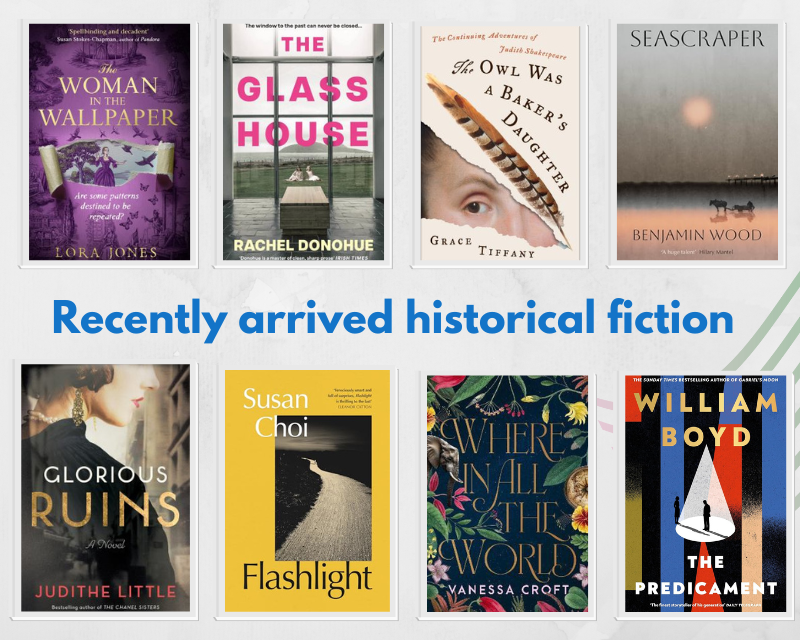
Escape into a riveting work of historical fiction, just in time for the busy season!
The Woman in the Wallpaper by Lora Jones
Against the backdrop of the French Revolution at a renowned Toile de Jouy wallpaper factory near Paris, two young woman find work. But soon, sisters Lara and Sofi notice an unsettling pattern: the factory owner's late wife, Madame Justine, who died under mysterious circumstances, is a recurring figure in the wallpaper designs. As Lara becomes involved with the owner's son, Josef, she is gripped by paranoia, realizing her life appears to mirror the tragic scenes depicted on the paper, suggesting a pre-ordained and sinister destiny. Meanwhile, Josef's aristocratic wife, Hortense, also becomes unnerved by the pattern. A historical novel rich in detail, mixed with a chilling gothic mystery, perfect for readers of Laura Purcell and Jess Kidd.
The Glass House by Rachel Donohue
A dark, lyrical mystery unfolding across dual timelines: 1963 and 1999. Sisters Aisling and Stella are growing up in an isolated modernist "Glass House" in Galway, dominated by their father, Richard Acklehurst, a controversial political philosopher with neo-fascist views. In 1963, Acklehurst dies mysteriously on New Year's Eve, casting a long shadow. In 1999, the defilement of his grave forces the sisters to return and confront the dark secrets, vengeance, and complex family dynamics rooted in their childhood. A dark and disturbing read.
The Owl was a Baker's daughter by Grace Tiffany
Now a 61-year-old midwife and apothecary in 17th-century England, Judith Shakespeare is forced to flee her hometown of Stratford to avoid arrest for witchcraft. Set during the tumultuous English Civil War, Judith's journey is complicated by her own grief over the loss of her adult sons to the plague and a strained marriage. Judith is an intelligent, resilient, and witty protagonist and despite the challenges of motherhood and aging in a patriarchal society, the enduring nature of human connection and a thirst for adventure shine through.
In the bleak, poverty-stricken Britain of the mid-1950s, Thomas Flett scrapes by, fishing for shrimp with a horse and cart to keep himself and his mother afloat. His world is confined to the dark, damp shores until a mysterious American filmmaker arrives in his small village, offering a way out of his meagre existence. Reminiscent of Audrey McGee’s The Colony, Seascraper is a coming-of-age story that offers a window into a vanished way of life on England’s coast while Wood's lyrical prose, interwoven with poetry and music, elevates the descriptions of the sea and sand into a beautiful and evocative reading experience.
Glorious Ruins by Judithe Little
In the scandalous années folles (roaring twenties) of Paris, world-famous muse Misia Sert and iconic designer Coco Chanel have an intense and unconventional friendship. Misia, married to muralist José María "Jojo" Sert, is challenged when the ambitious Russian sculptress Roussadana Mdivani enters their elite artistic circle, posing a threat to Misia's marriage and standing. A sweeping saga of art, love, and catastrophic greed, Little creates a rich atmosphere and vividly portrays the famous historical figures of this tumultuous period of history.
Seok is born in Japan to ethnic Koreans but after the war finds himself stateless as a young man. His family, drawn by promises of a Korean homeland leave for the DPRK and after a few letters both extolling the virtues of the socialist utopia and asking for seeds and basic clothes, all contact ceases. Leaving his one remaining sister in Japan, Seok, now Serk takes a position as a professor in the US, meets Anne and has a daughter, Louisa. And when Louisa is nine, on a sabbatical in Japan, Serk vanishes off a beach leaving a half drowned Louisa behind. Flashlight follows the intertwining stories of Serk, Anne and Louisa and Anne's older son Tobias both before and after Serk's disappearance, the cost of which severs the family almost entirely into pieces. Flashlight is both an intimate story of the history of one family and an expansive visit through the second half of the 20th century. It's bold and delicate, propulsive and elegant, and well deserving of a place on the 2025 Booker Prize shortlist.
Where in all the World by Vanessa Croft
In 1890s Canterbury, Harriet Watson longs for adventure beyond her family's sprawling homestead Rawahi. She is swept away by arrival of the charming English explorer, Curtis De Courcy, who undertakes a perilous African expedition to win her hand. After their marriage, Harriet's dreams dissolve into a reality of isolation and control as De Courcy's dark side and cruelty emerge, particularly during their time in the brutal Congo Free State. The novel is based on the real-life story of Gertrude Edith Watt, and critiques the violence of empire and the constrictions of Victorian marriage. It is ultimately a story of a woman's resilience, self-discovery, and fierce quest for freedom and self-reclamation.
The Predicament by William Boyd
The Predicament is William Boyd's second Cold War espionage novel, continuing the story of Gabriel Dax, a travel writer struggling to reconcile his professional life with his role as a reluctant spy. Set in the tense political climate of 1963, the book finds Dax unwillingly back in the shadows, partly drawn by the dangerous allure of his MI6 handler, Faith Green. His latest mission takes him first to turbulent Guatemala, where he is meant to cover a tinderbox presidential election but instead uncovers a sinister plot involving the CIA and the Mafia. Escaping to West Berlin, where President John F. Kennedy is scheduled to deliver his famous speech, Dax uncovers a high-stakes conspiracy: a plot to assassinate the American President. Forced into a race against time, the accidental agent must navigate a web of international deceit to avert a global tragedy.
