

I want to... Explore the Cosmos
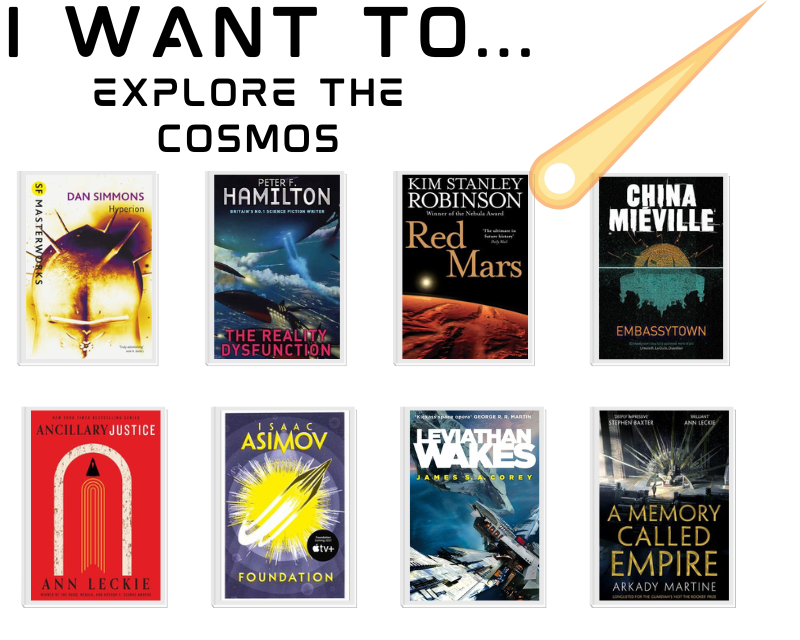
On the brink of intergalactic war, the Hyperion series begins with seven pilgrims journeying to Hyperion's Time Tombs to face the enigmatic and deadly Shrike. In Chaucer-esque style, the novel unfolds through their individual tales, a mosaic of space opera, horror, and myth, revealing their intertwined fates and connections to the mysterious planet. The latter books broaden the scope to the war between the Hegemony and the Ousters, as the secrets of the Shrike and the Time Tombs are unveiled, and the pilgrims' destinies converge with the fate of humanity. The series is a grand, character-driven epic blending vast scope with profound philosophical questions.
Night's Dawn trilogy by Peter F. Hamilton
In this weighty trilogy, Hamilton plunges a 27th-century humanity, split between tech-focused Adamists and bio-engineered Edenists across numerous worlds and poised on the edge of a golden age, into chaos. An ancient menace is returning from a terrifying "beyond," possessing the living and wielding formidable powers in a "reality dysfunction." The sprawling narrative follows individuals like the roguish Joshua Calvert, caught in the initial outbreak and seeking solutions, and the sinister Quinn Dexter, a leader among the Possessed with galactic ambitions. Louise Kavanagh fights for survival amidst the terror, while the Confederation Navy struggles to contain the escalating crisis. Political intrigue, ancient alien mysteries, and internal conflicts complicate the fight against the Possessed. Fans who enjoy intricate world-building, complex characters grappling with profound philosophical questions, and a blend of space opera with dark, otherworldly elements will find this series compelling. The detailed scientific concepts serve as a backdrop for a grander, more metaphysical conflict.
The Mars trilogy by Kim Stanley Robinson
Robinson's seminal series chronicles the ambitious and complex terraforming of Mars and the subsequent societal development, introduces the First Hundred colonists and their initial efforts to establish a foothold, marked by scientific endeavors and burgeoning political ideologies. We follow the generations born on the red planet as terraforming efforts intensify, leading to significant environmental changes and escalating conflicts between the original settlers and the new generations, as well as differing visions for Mars' future. Delving into the intricate societal structures that emerge, exploring themes of longevity, technological advancement, and the ongoing debate about humanity's relationship with its new world and the preservation of its Martian heritage, the series is a profound exploration of science, politics, and the human spirit in the face of an extraordinary undertaking.
On the alien world of Arieka, the enigmatic Ariekei, or Hosts, maintain a precarious trade alliance with the human colony of Embassytown. This relationship is uniquely strained by the Ariekei's "Language," a form of communication biologically impossible for humans to articulate. To bridge this linguistic divide, genetically engineered human Ambassadors, always pairs of twins speaking in unison, serve as intermediaries. However, the arrival of a singular new Ambassador named Ez/Ra shatters this delicate equilibrium. Unlike his predecessors, Ez/Ra possesses an unprecedented ability to speak Language, an ability that exerts an intoxicating and transformative influence on the Hosts. As this linguistic manipulation causes Ariekei society to fracture, Embassytown descends into turmoil. Embassytown is a complex and profound musing on how language shapes thought and culture, and the formidable obstacles inherent in communicating with the truly alien.
The Imperial Radch series by Ann Leckie
The Imperial Radch series centers on Breq, the sole surviving fragment of the AI of a destroyed Radchaai warship, Justice of Toren. The Radchaai are a gender-blind, expansionist human empire utilizing human "ancillaries" as extensions of their ship AIs. The trilogy begins with Ancillary Justice, where Breq seeks revenge against the multi-bodied Lord of the Radch, Anaander Mianaai, for the ship's destruction. The series is a thought-provoking exploration of AI, power, and what it means to be human, set against a backdrop of interstellar politics and unique linguistic structures and introduces some truly alien aliens.
In a declining Galactic Empire, Hari Seldon, a mathematician, develops "psychohistory," a science that predicts the future of large populations. He foresees the Empire's collapse and a 30,000-year dark age. To mitigate this, Seldon establishes the Foundation on the remote planet Terminus. Posing as a scientific expedition to compile the Encyclopedia Galactica, its true purpose is to follow Seldon's Plan: a series of calculated crises that will steer humanity towards a new, shorter dark age and the eventual rise of a Second Empire. Foundation's epic and sweeping scale has influence science fiction writing for generations and Asimov's ideas have captured the imaginations of scientists, historians, and technologists.
The Expanse series by James S.A Corey
Tensions between Earth, Mars, and the Belters (those living at the farthest reaches of humanity's outward colonisation), who face harsh conditions and exploitation. A series of events, including the discovery of a mysterious alien protomolecule - that has the power to drastically alter biological matter, throws the solar system into chaos. Soon various factions are vying for control of it, leading to political intrigue, war, and widespread destruction. The series follows the ragtag crew of the Rocinante, a former Martian naval vessel as they become entangled in the conspiracies and conflicts surrounding the protomolecule, uncovering ancient secrets and facing powerful adversaries. As the series progresses, humanity is forced to confront not only its own internal divisions but also the existence of forces beyond their comprehension, as the protomolecule opens a gateway to interstellar travel and contact with ancient alien civilizations.
The Texicalaan Empire by Arkady Martine
In the sprawling Teixcalaanli Empire, an interstellar civilization with a rich, complex culture inspired by ancient Aztec society, Mahit Dzmare is an ambassador from the small, independent space station/nation of Lsel Station. When her predecessor dies under suspicious circumstances, Mahit must navigate the intricate political landscape of the capital, Teixcalaan, to find the truth and protect her station's interests. She relies on her imago, a brain implant containing the memories and identity of her predecessor. As Mahit investigates, she uncovers conspiracies that reach the highest levels of the Empire, threatening the stability of the entire galaxy. The series is known for its intricate world-building, poetic language, and exploration of power, culture, and belonging.
