

I want to... see history through art
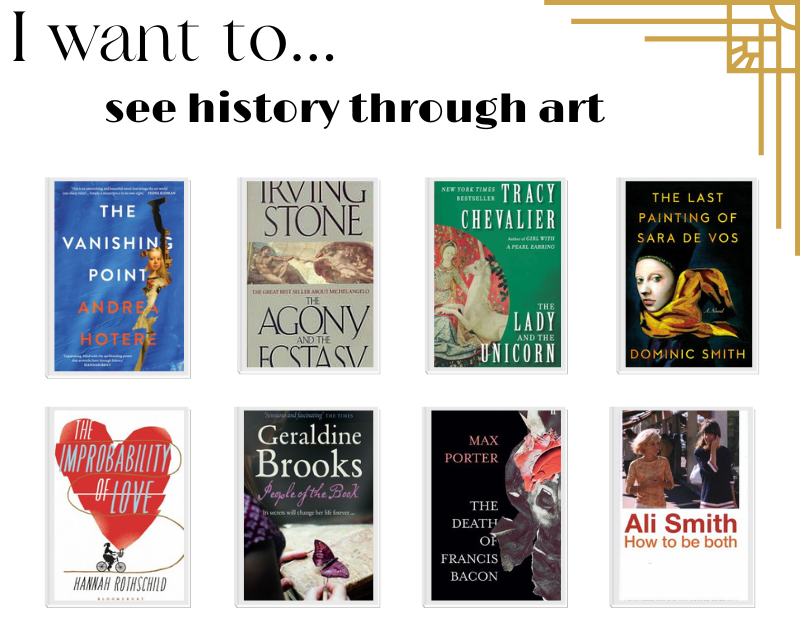
See the world through the lens of art with these fascinating works of fiction.
The Vanishing Point by Andrea Hotere
In 1656, Diego Velázquez painted Las Meninas, capturing the Spanish court under King Philip IV and his wife Mariana. Central to the scene is the Infanta Margarita, Philip's curious five-year-old daughter, surrounded by her ladies-in-waiting, dwarfs, and guards. Hotere's story transports us to the heart of the Alcazar, weaving a tapestry of lives: the sheltered Infanta, the observant painter Velázquez, and the drama-filled court shaped by both fervent religious devotion and hidden corruption in the shadow of the Spanish Inquisition.
To be read in the Museo Nacional del Prado, Madrid
The Agony and the Ecstasy by Irving Stone
Vividly portraying Michelangelo Buonarroti's tumultuous journey as a sculptor, painter, and architect during the Italian Renaissance, the 'agony' of relentless work and demanding patrons like Pope Julius II, the "ecstasy" of representing the profound artistic fulfilment and spiritual connection he achieved through his masterpieces. The novel is rich in creative process, genius, and the sacrifices made for art, ultimately highlighting the intense human drama behind timeless creations.
To be read in the Sistine Chapel, Vatican City
The Lady and the Unicorn by Tracy Chevalier
Set in late 15th-century France and Brussels, the story follows the commissioning nobleman Jean Le Viste, the charismatic artist Nicolas des Innocents who designs them, and the master weaver Georges de la Chapelle. The novel explores the intricate process of tapestry making and how the lives and desires of the various characters—including the women of Le Viste's household and the weaver's blind daughter—subtly influence the tapestries' themes of the five senses and the mysterious "À mon seul désir." Chevalier masterfully blends historical detail with compelling human drama, revealing the passions and secrets woven into these timeless works of art.
To be read at the Musée de Cluny, Paris
The Last Painting of Sara de Vos by Dominic Smith
Smith skilfully interweaves three lives - Sara de Vos, a fictional 17th-century Dutch female painter who creates a landscape despite societal constraint; Marty de Groot, a wealthy 1950s New Yorker whose inherited de Vos painting is stolen and replaced with a forgery; Ellie Shipley, an Australian art history student in 1950s New York who is commissioned to paint that very forgery, and later becomes a renowned art historian. As Ellie prepares an exhibition of Dutch Golden Age female painters in 2000, both the original de Vos and her own forgery are set to arrive, threatening to unravel her carefully constructed life.
To be read at the Rijksmuseum, Amsterdam
The Improbability of Love by Hannah Rothschild
This vibrant, satirical novel set in the high-stakes world of the London art market centres on Annie McDee, a young chef who impulsively buys a dusty painting from a junk shop. Unbeknownst to her, it's a long-lost masterpiece by the 18th-century French painter Antoine Watteau, titled "The Improbability of Love." The novel cleverly uses the painting itself as a narrator for parts of the story, giving it a unique perspective on its journey through history and the lives of its various owners, from European royalty to Nazi art thieves. As Annie discovers the painting's true value, she is drawn into a thrilling and dangerous world populated by eccentric billionaires, ruthless dealers, and desperate auctioneers all vying to possess the artwork.
To be read at the British Museum, London
People of the Book by Geraldine Brooks
In late 1990s Australian book conservator Hannah Heath meticulously examines the rescued Sarajevo Haggadah, a real, richly illuminated medieval Jewish manuscript discovering tiny clues—a butterfly wing, a wine stain, salt crystals, a white hair—within its ancient binding. Each discovery sparks a fascinating leap back in time, revealing the diverse "people of the book" who protected, owned, or influenced the manuscript through centuries of upheaval. From medieval Spain during the Inquisition to fin-de-siècle Vienna, and from Nazi-occupied Sarajevo to a Venice ghetto, Brooks vividly portrays lives intertwined with the book's survival.
To be read at the National Museum of Bosnia and Herzegovina, Sarajevo
The Death of Francis Bacon by Max Porter
Rather than a straightforward biography, Porter crafts an experimental novella, a series of "word paintings" – fragmented, visceral prose and poetry set during Bacon's final, delirious days in a Madrid hospital – that mimic Bacon's own artistic style. Attended by a nun, Sister Mercedes, Bacon's thoughts oscillate between the past and the present, between philosophical musings and raw, bodily sensations. Porter's unique approach aims to "get art history out of the way" and let the intensity and disturbing beauty of Bacon's inner world speak for itself, offering a profound, if challenging, meditation on art, memory, and the end of life.
To be read in the Hugh Lane Gallery, Dublin
in typical beguilling Ali Smith fashion, How to be Both is a novel in two parts, which can be read in either order. One narrative follows George, a modern day British teenager grappling with the sudden death of her mother, an activist and art lover. The other, set in 15th-century Italy, tells the story of Francescho, a talented Renaissance painter, who is secretly a woman living as a man to pursue her art. Themes of identity, the power of art, and memory intertwine as George becomes fascinated by Francescho's frescoes, creating a profound, almost mystical connection across centuries.
To be read at the Museo Schifanoia, Ferrara
