

I want to... escape into magical realism
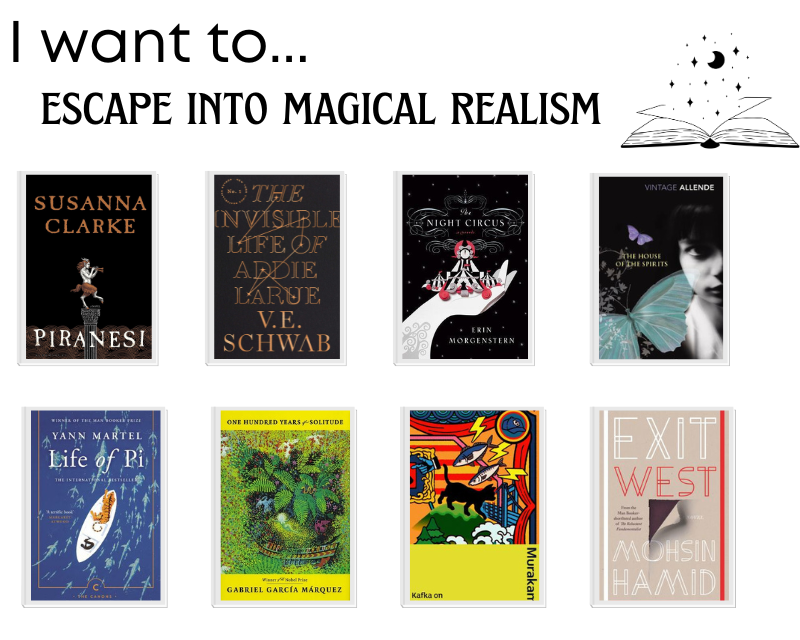
When the boundaries between real and unreal, between our world and another are blurred, magical realism steps in to guide the reader on an often times surreal trip. Here are some of our favourites.
Clarke's Women's Prize winning second novel blends elements of fantasy, mystery, and even philosophical inquiry. The story is told through the journal entries of its titular character, Piranesi who lives in an enormous, labyrinthine 'House' comprised of countless halls, vestibules, and staircases, all filled with thousands upon thousands of unique statues. Piranesi believes this House is the entire world, his only human contact is "The Other," a mysterious man who visits him twice a week to discuss their shared research into a "Great and Secret Knowledge" hidden within the House. While Piranesi flirts with conventional fantasy and even dark academia elements as its plot unravels, its core strength as a work of magical realism lies in its masterful creation of a fantastical world that is utterly believable within its own terms, presented through the eyes of a character who accepts its inherent magic as simply the way things are.
The Invisible Life of Addie Larue by V.E Schwab
In 18th-century France, a young woman named Adeline LaRue, desperate to escape a forced marriage and a provincial life, makes a desperate bargain with a mysterious entity. In exchange for eternal life, she is cursed to be forgotten by everyone she meets. For 300 years, Addie navigates this lonely existence, traveling the world, observing history, and struggling to leave a mark. She learns to steal to survive, to influence artists to subtly spread her essence, and to endure profound isolation. Everything changes when, in a small New York City bookstore in 2014, she meets Henry Strauss, a young man who, inexplicably, remembers her. Their meeting unravels centuries of loneliness and sets them on a poignant and complicated journey. While the novel straddles many fantasy sub-genres, it's symbolic exploration of human experience within an otherwise realistic world firmly positions it within the realm of magical realism.
The Night Circus by Erin Morgenstern
Le Cirque des Rêves (The Circus of Dreams), a mysterious, travelling circus that appears without warning, its striped tents appearing overnight, and is only open from sunset to sunrise. This isn't just any circus; it's a breath-taking, fantastical spectacle powered by real magic. Celia Bowen and Marco Alisdair are two young magicians caught up in a clandestine competition, having been trained since childhood by their eccentric and demanding mentors for this very purpose: a duel of skill and imagination, with the circus itself as their arena. Neither Celia nor Marco fully understand the rules or the stakes of their lifelong game, only that they must create increasingly elaborate and wondrous magical exhibits within the circus. As the years pass and their creations grow, they unwittingly fall in love, a forbidden romance that complicates their magical duel and has profound consequences for the circus and everyone connected to it.Morgenstern's hugely popular novel is a prime example of a book that blurs the lines between fantasy and magical realism, often leaning heavily into the latter due to its unique approach to magic and its immersive atmosphere.
The House of Spirits by Isabel Allende
Often cited as a quintessential example of magical realism, Allende's masterpiece is frequently compared to One Hundred Years of Solitude due to its multi-generational family saga and its seamless integration of the fantastical into a realistic, politically charged narrative. The novel chronicles the lives of the Trueba family over several generations in an unnamed Latin American country (strongly reminiscent of Chile, Allende's homeland). The story begins with the del Valle family, particularly focusing on the clairvoyant Clara, who can communicate with spirits, predict the future, and even move objects with her mind. She marries the tempestuous and ambitious Esteban Trueba, a self-made patriarch who builds his wealth through his hacienda, "Las Tres Marías." The story is largely told through the eyes of the women in the family, particularly Clara's journals and her granddaughter Alba's later narration, providing a deeply personal perspective on the sweeping historical events. Allende employs magical realism by seamlessly blending the extraordinary with the ordinary, grounding fantastical occurrences in a tangible historical setting, and using these magical elements to deepen the exploration of universal themes such as love, family, memory, destiny, political oppression, and the enduring human spirit.
Martel's Booker Prize winning story of Piscine "Pi" Patel, an Indian boy who survives a shipwreck while his family is relocating their zoo from India, to Canada uses the fantastical to explore deep questions about faith, truth, and the human condition. It doesn't just tell a magical story; it asks why we tell and believe magical stories. For the vast majority of the novel, Pi recounts his incredible journey with Richard Parker, the Bengal tiger, with an earnest, unwavering conviction. The presence of a tiger on a small lifeboat, their bizarre co-existence, and even the existence of the carnivorous algae island are presented as factual occurrences within Pi's narrative. The author doesn't explicitly label these events as magical; rather, they are simply part of Pi's lived experience. This matter-of-fact presentation of the impossible is a core tenet of the genre and Martel does it with unique aplomb and style.
One Hundred Years of Solitude by Gabriel García Márquez
One Hundred Years of Solitude is a seminal work of magical realism, often considered the defining work, blurring the lines between what is "real" and what is "magical," and prompting readers to question their own understanding of reality. García Márquez transforms the Buendía family and the town of Macondo into a kind of sprawling, epic myth, suggesting that history is not a linear progression but a series of recurring patterns. This seamless integration of the extraordinary into the ordinary is a hallmark of magical realism, and One Hundred Years of Solitude achieves it with unparalleled skill.
Kafka on the Shore by Haruki Murakami
The Japanese master novelist is one of the most prominent contemporary writers of magical realism, and Kafka on the Shore is a quintessential example of his style. The novel seamlessly weaves together the mundane and the surreal, creating a unique world where the fantastical is simply an accepted part of reality. The novel follows two seemingly disparate storylines that eventually intertwine. One narrative thread centres on Kafka Tamura, a 15-year-old runaway who flees his Tokyo home to escape an Oedipal prophecy and embark on a journey of self-discovery. Throughout his journey, Kafka is accompanied by an alter ego, Crow, who offers guidance and warnings. The second narrative focuses on Satoru Nakata, an elderly man who lost his ability to read and write due to a mysterious incident during World War II. However, this incident left him with the unique ability to talk to cats. After a bizarre series of events involving a cat-killing villain named Johnnie Walker, Nakata embarks on a journey that ultimately connects him to Kafka's path and the deeper mysteries of the world.
This narrative about migration, displacement, and the search for belonging in a world grappling with immense upheaval, while not as overtly fantastical as some other magical realist works is undeniably supernatural and serves as a powerful metaphor for contemporary global issues. The story begins in an unnamed, war-torn city (strongly implied to be in the Middle East) where a young couple, Saeed and Nadia, meet and fall in love amidst the escalating violence. As their city becomes increasingly dangerous and uninhabitable, they learn of mysterious "doors" that can instantly transport people to other parts of the world. Desperate for survival and a chance at a new life, Saeed and Nadia decide to use one of these doors, embarking on a perilous journey through a series of different locations across the globe – a crowded migrant camp on the Greek island of Mykonos, a luxurious London mansion, and eventually a sprawling Californian commune. Hamid explores the complex, often surreal, realities of forced migration and human connection with a unique and powerful perspective that transcends mere literal representation.
